If you're searching for "in-house financing near me", "bad credit car dealerships in Salt Lake City", or even considering a lease because it looks more affordable upfront — this guide was written for you. We're going to show you exactly what a lease really costs, how it can make your financial situation dramatically worse, and why buying and owning your vehicle is almost always the smarter decision.
$0
Equity built after a lease ends
40+
Years helping SLC drivers get approved
100%
Ownership when you finance at First Class Cars
What Is a Car Lease — Really?
A car lease is not a purchase. It's a long-term rental contract where you pay monthly to use a vehicle for a set period — typically 24 to 48 months — and then hand the keys back at the end. You never own it. You never build equity. And despite making hundreds of payments, you walk away with nothing.
Financial experts consistently describe leasing as the most expensive way to drive a vehicle. You're essentially paying for the sharpest portion of a car's depreciation — its steepest value drop — while the leasing company retains ownership the entire time.
"Leasing is the most expensive way to drive a car. You pay for the fastest loss in value, you pay fees on both ends, and you walk away with nothing to show for it."
— Widely cited personal finance principle
Why Leasing Is Especially Dangerous With Bad or No Credit
For anyone with credit challenges, a car lease creates a uniquely fragile situation. Leasing companies typically require good-to-excellent credit scores to begin with — often 700 or above. But even if you qualify, the structure of a lease can accelerate financial stress when life gets complicated.
The Hidden Traps of Car Leasing
- No ownership whatsoever: Years of payments and you leave with zero asset, zero equity, and zero financial progress.
- Strict mileage limits: Typically 10,000–15,000 miles per year. Exceed the limit and you'll pay a per-mile penalty at return — often 15–25 cents per mile over.
- Wear-and-tear charges: Minor scratches, small dents, worn tires — the dealer decides what's "excessive," and the bills can reach hundreds or thousands of dollars.
- Front-end fees you don't see coming: Acquisition fees, documentation fees, title fees, registration fees — all before you drive a mile.
- Back-end fees at lease end: Disposition fees, mileage penalties, damage fees — a final bill at the worst possible moment.
- Nearly impossible to exit early: Breaking a lease mid-term can cost as much as continuing to pay through the end. You're locked in with no escape hatch.
Leasing vs. Owning: Side-by-Side
| Factor |
🚫 Leasing |
✅ In-House Financing (Own It) |
| Do you own the car? |
Never. You return it. |
Yes — fully yours after payoff |
| Mileage restrictions |
10,000–15,000 mi/year cap |
Drive as much as you want |
| Build equity |
Zero equity, ever |
Every payment builds toward ownership |
| Fees at the end |
Disposition, damage & mileage fees |
None — you own it free and clear |
| Exit flexibility |
Extremely expensive to exit early |
Pay off early, sell, or trade anytime |
| Credit score needed |
Usually requires 700+ credit |
All credit types welcome at First Class Cars |
| Long-term cost |
Pay forever, own nothing |
Payments end. Asset stays. |
| Modifications allowed |
Must return car to stock condition |
Your car — do what you want |
Do you own the car?
Leasing — Never. You return it at the end.
First Class Cars — Yes, fully yours after payoff.
Mileage restrictions
Leasing — 10,000-15,000 mi/year hard cap with per-mile penalties.
First Class Cars — Drive as much as you want. No limits.
Build equity?
Leasing — Zero equity. Ever.
First Class Cars — Every payment builds toward full ownership.
Fees at the end
Leasing — Disposition, damage and mileage fees.
First Class Cars — None. You own it free and clear.
Exit flexibility
Leasing — Extremely expensive to exit early.
First Class Cars — Pay off early, sell, or trade anytime.
Credit score needed
Leasing — Usually requires 700+ credit score.
First Class Cars — All credit types welcome.
Long-term cost
Leasing — Pay for years, own nothing.
First Class Cars — Payments end. The asset stays yours.
⚖ Legal Reality
What Really Happens If You Miss Lease Payments in Utah
This is the part nobody talks about — and it's especially important if your finances are already tight. With a lease, you don't own the vehicle. That means the leasing company has full legal authority to repossess it, and quickly.
- Rapid repossession: Unlike a financed vehicle where there may be some negotiation room, lease repossession can happen after just one or two missed payments. You have fewer legal protections.
- You still owe money after repossession: Even if the vehicle is taken, you may still be liable for remaining payments, fees, and deficiency balances.
- Hiding the vehicle is a serious crime in Utah: Concealing a leased vehicle from a lessor attempting to repossess is considered fraud. It can result in criminal charges, civil liability, and a lasting mark on your record — far beyond a damaged credit score.
- Contract penalties stack up: Early termination fees, repossession fees, storage fees, and collection costs can add thousands of dollars to what you already owe.
- Your credit takes a severe hit: A lease default or repossession can drop your credit score by 100+ points and stay on your report for seven years — making future vehicle purchases, housing, and even employment harder.
The bottom line: a lease provides you the least protection and the most exposure when financial hardship strikes. And hardship can strike anyone.
The Total Cost of Leasing: A Story in Three Acts
Act 1: The Low Monthly Payment That Isn't Low
Dealers advertise low monthly lease payments because they're calculating only the depreciation portion of the vehicle's value, plus interest and fees. But those fees add up. The acquisition fee, documentation fee, first and last month's payment upfront — you're often spending $2,000–$4,000 before you ever drive off the lot.
Act 2: The Payments That Never Build Anything
Over a 36-month lease, you might pay $15,000–$25,000 in monthly payments. That money is completely gone. You own no asset. You have no trade-in value. You have nothing to sell. You've simply paid to borrow a car.
Act 3: The Surprise Bill at the End
Lease-end often brings a final bill: a disposition fee (typically $300–$500), excess mileage charges, wear-and-tear assessments. Many lessees are shocked to receive a bill for $500–$3,000 right as they're returning the vehicle. Then the cycle starts again — or worse, they're left without transportation.
The Brutal Math of Leasing
- You pay for depreciation — the fastest, steepest part of a car's value loss
- You pay interest on a car you'll never own
- You pay fees on the front end and fees on the back end
- You may pay penalties for mileage and wear throughout
- Result: Thousands spent. Zero asset. Back to square one.
The Better Path: In-House Financing and Real Ownership
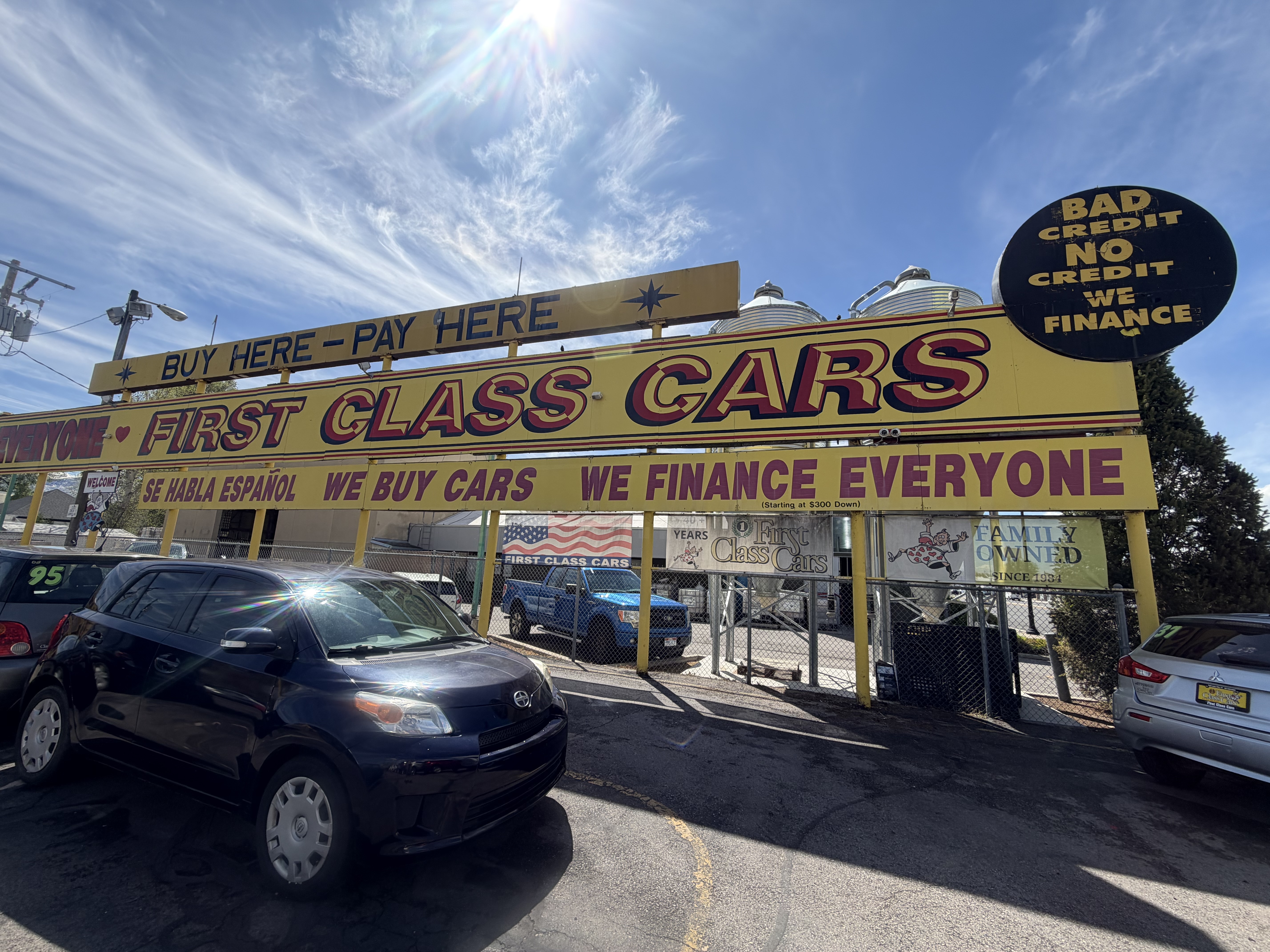
At First Class Cars in Salt Lake City, we've been doing one thing for over 40 years: helping real people get into reliable vehicles they can actually own. Not rent. Not lease. Own.
Our in-house financing means we are the lender. We don't send your application to a bank or third party. We work directly with you — based on your situation, your income, and your ability to repay — not just a credit score number.
⭐Bad Credit
🆕No Credit
✅Good Credit
🔑First-Time Buyers
↗Rebuilding Credit
- You own the car — the title is in your name, not a leasing company's
- No mileage restrictions — drive to work, across the state, wherever life takes you
- No wear-and-tear penalties — normal use is expected, not penalized
- Payments end — once you pay it off, $0 per month. Forever.
- Build real stability — an owned vehicle is an asset. A leased vehicle is an expense.
- More flexibility — sell it, trade it, keep it. Your choice, not a contract's.
1984
Serving Salt Lake City for Over 40 Years
We've helped thousands of Utah drivers get approved and back on the road — people with all kinds of credit situations. Our process is straightforward, honest, and built around getting you into a vehicle you can afford and own.
The Principles Are Simple — and They're Right
Financial educators like Dave Ramsey have long warned against vehicle leasing, calling it "fleecing" — because the leasing company always comes out ahead. The principles behind that position hold up:
- Leasing means going into debt for something you'll never own
- The "lower monthly payment" hides the true total cost
- Dealers aren't legally required to disclose the interest rate in a lease
- Buying a reliable used car and paying it off is almost always cheaper long-term
- Owning an asset — even a modest used vehicle — is better than perpetually renting one
You don't have to be wealthy to make a smart financial decision. You just have to choose ownership over appearance — and a dealership that actually works with you to get there.
"It's better to be wealthy than to look rich. An owned used car serves you. A leased new car serves the dealer."
— Core principle of sound personal finance






 Luxury (2)
